
ANALYSIS · GLOBAL EQUITIES · SPCX
SpaceX stock: Q3 profit meets the cash-flow test
Quarterly earnings have improved. The investment case still depends on the cash required to turn expansion into shareholder value.
Bourse Istanbul editorial desk · 6 min read
Published
Updated
SpaceX reported third-quarter revenue of $14.575 billion and net income of $4.404 billion. For investors studying SpaceX stock, the investment question is whether stronger earnings can support the cost of expansion. Source: Q3 Form 10-Q, page 5.
The company trades on Nasdaq as SPCX, following its June 2026 listing. Its $135 initial offering price is a historical reference, not a current quote or an estimate of fair value. Source: Nasdaq's listing report.
| Metric | Q3 2026 |
|---|---|
| Revenue | $14.575 billion |
| Operating income | $2.791 billion |
| Net income | $4.404 billion |
| Diluted earnings per share | $0.35 |
Why net profit is not the whole earnings story
Operating income was about 19.1% of revenue, our calculation from the reported figures. Net income was higher than operating income: the quarter included $198 million of net interest income, $1.025 billion of other income and a $390 million income-tax benefit. The first nine months still recorded a $413 million net loss. Source: income statement, page 5.
These distinctions matter when valuing the shares. A model that simply multiplies one quarter's bottom-line profit by four assumes that the tax and non-operating contributions will recur. A more useful approach is to forecast the operating businesses, then model financing costs, taxes and other items separately. Strong quarterly profit is evidence of progress; it is not, by itself, a sustainable annual earnings estimate.
Profit and available cash answer different questions
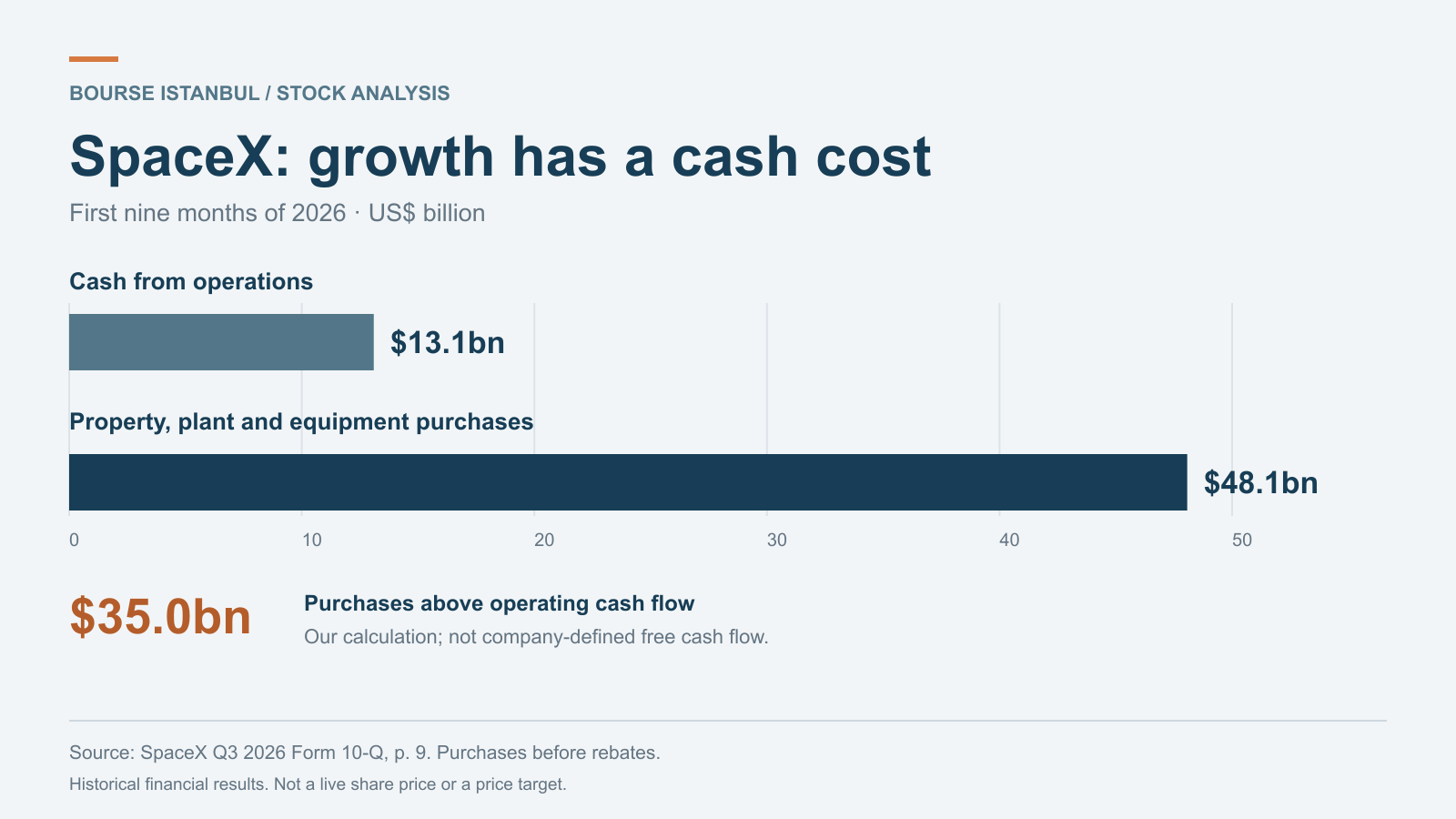
During the first nine months of 2026, SpaceX generated $13.097 billion of operating cash flow and spent $48.069 billion on purchases of property, plant and equipment, before separately reported rebates. These cover a longer period than the earnings table above. Source: cash-flow statement, page 9.
Subtracting those purchases from operating cash flow gives a $34.972 billion shortfall. This is our narrow calculation, not a company-defined free-cash-flow measure; it excludes rebates, capitalized interest and other investing items.
Our interpretation is that quarterly profitability and the funding demands of expansion need separate attention. A business can earn a profit while consuming substantial cash to build assets. That can be sensible when the assets later earn attractive returns. It becomes a problem when new capacity costs more than the value it creates.
Heavy spending does not mean an immediate funding crisis
The balance sheet also needs to be in the picture. SpaceX reported $89.855 billion of cash and marketable securities at 30 September. Its nine-month cash-flow statement records $85.675 billion of net IPO proceeds and $99.819 billion of net financing inflows overall. Source: balance sheet and cash-flow statement, pages 4 and 9.
The cash gap therefore cannot be read as proof that SpaceX is about to run out of money. The sharper investment question is what return that funding will earn. A large liquidity balance can support a long investment programme, but financing inflows are different from cash generated by customers. Investors should track both the remaining funding cushion and the evidence that new assets are producing economic returns.
What would strengthen the investment case?
The composition of the business matters. SpaceX's Superintelligence segment reported $7.560 billion of Q3 revenue and $39.995 billion of nine-month capital expenditure. That is about 52% of group revenue and 83% of group capital expenditure in their respective periods, calculated from the filing. Source: segment disclosures, pages 32–33.
Those figures make this more than a bet on launches and satellite subscriptions. A large share of the investment case depends on the demand, utilization and economics of the AI business. Strong performance in connectivity cannot, on its own, demonstrate that a much larger computing investment programme will earn its cost.
A useful starting point is to compare operating cash generation with reinvestment over several reporting periods. One quarter can be distorted by the timing of customer payments, supplier bills or construction. A sustained improvement would carry more weight than a single favourable observation.
For a company combining satellite connectivity, launch services and computing, a valuation should distinguish their economics. Recurring subscriptions, mission revenue and compute contracts need different assumptions about demand, pricing, useful asset lives and replacement spending. A forecast that assigns one growth rate to everything conceals those differences.
The bullish scenario is that spending creates capacity customers use profitably, while established operations generate more cash. The bearish scenario is that utilization or pricing disappoints and further financing becomes necessary. These are analytical scenarios, not predictions of SpaceX's next results.
Three tests for a SpaceX valuation
- Cash conversion. Compare the change in revenue with operating cash generation, and examine working-capital movements before treating an improvement as durable.
- Return on investment. Distinguish announced capacity from capacity in use and revenue earned. The financial return matters more than the size of the construction programme.
- Value per share. Account for debt, cash and dilution. A growing company does not automatically deliver a comparable return to each shareholder.
A practical valuation should include a slower-growth case and a case in which expansion takes longer to pay back. If a modest delay removes most of the estimated upside, the valuation leaves little room for execution risk. Without a verified current price and a complete valuation model, this article does not establish whether SPCX is cheap or expensive.
A currency lens for international investors
Readers measuring returns in Turkish lira should separate the dollar share-price return from the currency effect. For example, an illustrative 10% dollar gain combined with a 5% rise in USD/TRY gives a 15.5% lira gain before costs: 1.10 × 1.05 − 1. Neither assumption is a forecast. Currency movements can also reduce returns.
The research priority is the connection between earnings, investment and eventual cash returns. Evidence that new assets earn their cost would strengthen the investment case. An attractive product or a profitable quarter alone cannot settle the valuation.
Sources and editorial note
- SpaceX: Form 10-Q, quarter ended 30 September 2026, signed 22 October (pp. 4, 5, 9 and 32–33) ↗
- SpaceX: Q3 2026 earnings and original filing links (20 October 2026) ↗
- Nasdaq: SpaceX begins trading as SPCX (12 June 2026) ↗
Updated 4 November: expanded the earnings-quality and funding analysis and added the cash-flow chart. The original publication date is unchanged. Original analysis prepared with AI assistance using the public sources above. No interviews or independent operational verification were conducted. Calculations, interpretations and illustrative scenarios are identified in the text. This is educational analysis, not personalized investment advice. About the editorial desk · Editorial standards. For corrections, contact sales@bourseistanbul.com.